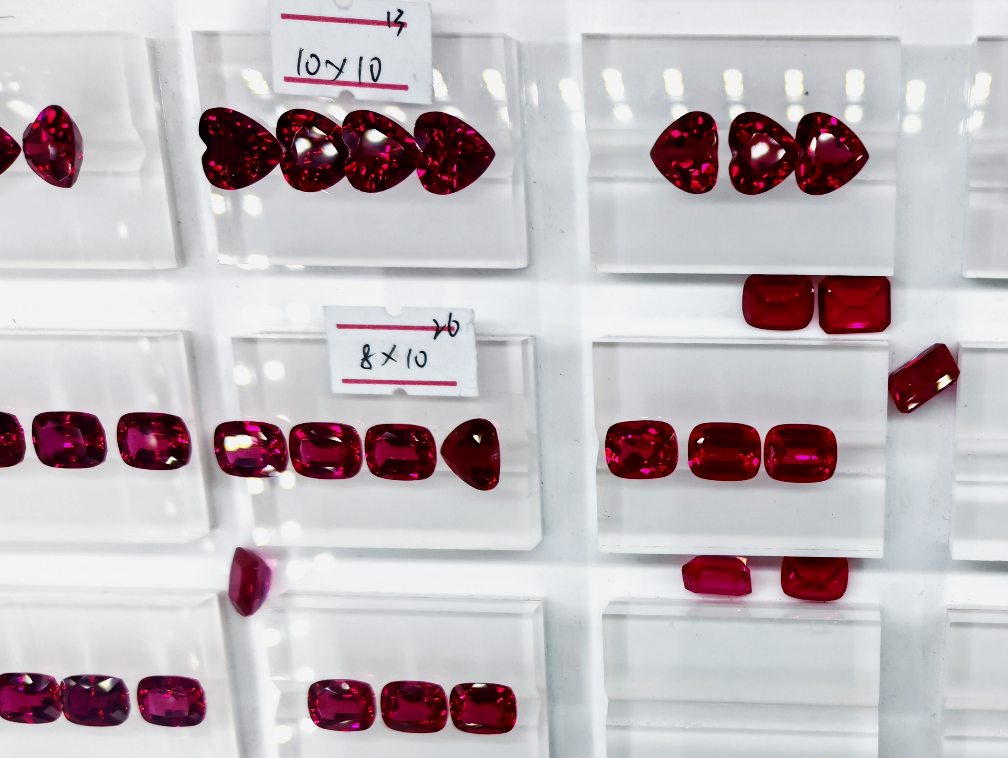
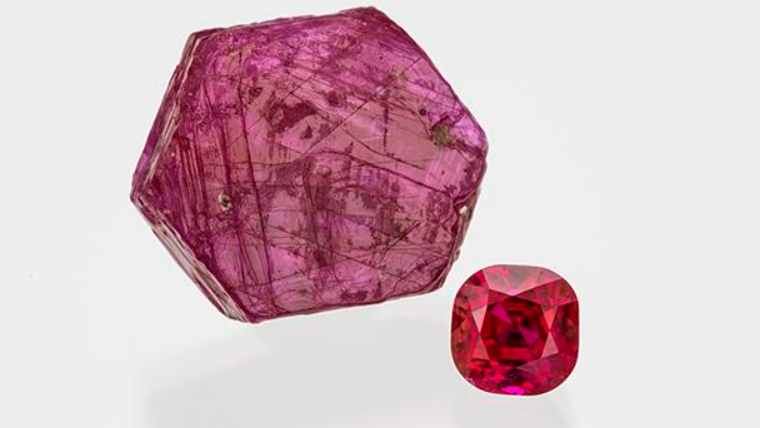
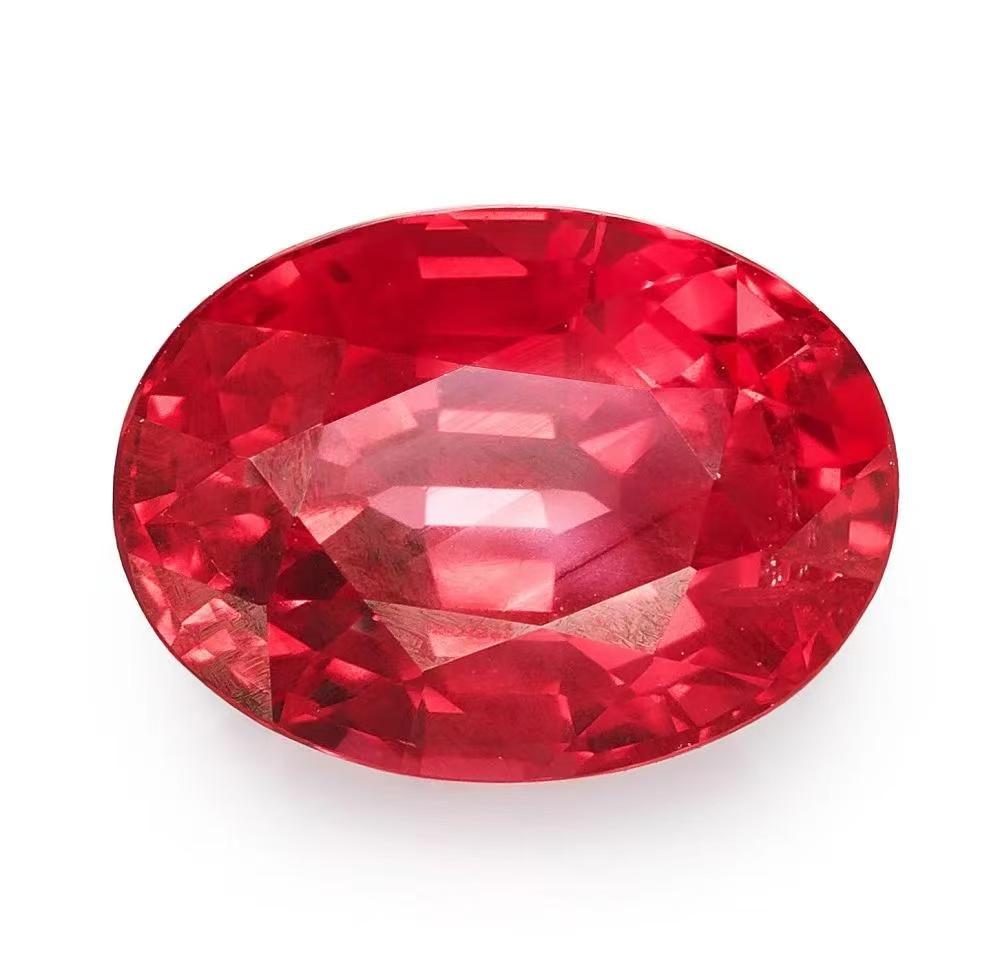
Most sources will tell you that synthetic ruby has a hardness of 9 on the Mohs scale, just like natural ruby. But if you stop there, you’re only scratching the surface—ironically, not something ruby would let you do easily.
🔬 The Mohs Scale Is Just the Beginning
The Mohs hardness scale is ordinal—it tells you which mineral can scratch which, but not how much harder one is than another. For example:
- Talc (1) vs. Gypsum (2) → ~2x harder
- Corundum (ruby) (9) vs. Diamond (10) → Diamond is ~140x harder
So although ruby ranks high, the difference between it and diamond is massive in absolute terms.
➡️ In absolute hardness terms:
- Vickers hardness: 2,000–2,200 HV
- Knoop hardness: 2,100–2,200 HK
Compare that to diamond:
- Vickers hardness: ~10,000 HV
🧪 Why Synthetic Ruby Can Be Harder Than Natural Ruby
Here’s something many people overlook:
High-purity synthetic rubies often show better hardness consistency and performance than natural ones.
This is due to:
- Minimal crystal defects and no inclusions
- Precise chromium (Cr³⁺) doping for color, without weakening the structure
- Controlled growth (like Verneuil or Czochralski methods)
🧭 Directional Hardness (Anisotropy)
Synthetic ruby is anisotropic—its hardness varies slightly depending on the direction:
- Hardness is slightly lower along the optical (c-axis) direction
- This affects wear resistance in industrial and optical applications
🔍 Real-World Uses
- Watches: Ruby bearings reduce friction and wear
- Lasers: Ruby rods used for solid-state lasers due to thermal and mechanical hardness
- Semiconductors: Ruby’s cousin, synthetic sapphire, is used as a substrate
✅ Summary
| Metric | Value |
|---|---|
| Mohs Hardness | 9 |
| Vickers Hardness | 2,000–2,200 HV |
| Knoop Hardness | ~2,100 HK |
| Crystal Uniformity | Higher in synthetic rubies |
| Directional Variance | Yes (anisotropic) |
📌 Final Thought
Don’t settle for a simple “9” on the Mohs scale. Synthetic ruby is a feat of precision materials engineering—with hardness properties fine-tuned for everything from lasers to luxury watches.
📚 FAQ: Hardness of Synthetic Ruby
Q1: Is synthetic ruby as hard as natural ruby?
Yes—and in many cases, it’s even harder in practical applications. Synthetic rubies have fewer flaws and a more uniform crystal structure, which can make them more resistant to wear.
Q2: Can synthetic ruby scratch glass or steel?
Definitely. Glass typically has a Mohs hardness of ~5.5, and steel varies from 4–7. Ruby (Mohs 9) easily scratches both.
Q3: What makes synthetic ruby hard?
Synthetic ruby is made of aluminum oxide (Al₂O₃) with a small amount of chromium (Cr³⁺). The tightly bonded hexagonal lattice gives it exceptional hardness.
Q4: Does heating or radiation affect ruby hardness?
Not significantly. Ruby is stable up to ~2,000°C. However, thermal shock and radiation can affect color or induce microcracks if poorly manufactured.
Q5: Is hardness the same as toughness?
No. Hardness is resistance to scratching. Toughness is resistance to cracking. Ruby is hard but not very tough—it can chip or shatter under sharp impact.
Q6: Is ruby harder than sapphire?
Technically, no. Ruby and sapphire are both forms of corundum (Al₂O₃), just with different trace elements. Their hardness is essentially the same—Mohs 9.
Q7: Can ruby hardness vary?
Yes. Natural rubies with inclusions or poor crystallinity may be softer. Synthetic rubies grown under controlled conditions are typically harder and more uniform.