Rubies, known for their intense red color and exceptional hardness, are among the most prized gemstones in the world. One fascinating characteristic of rubies is their ability to fluoresce—meaning they emit a visible glow when exposed to ultraviolet (UV) light. But do synthetic rubies fluoresce the same way natural rubies do?
In this article, we explore the science behind fluorescence in rubies, compare how natural and synthetic rubies behave under UV light, and explain how this property helps gemologists identify real versus synthetic stones.
What Is Fluorescence in Gemstones?
Fluorescence is the emission of visible light by a substance when it is exposed to UV or other high-energy light sources. In gemstones, this effect is usually caused by trace elements or crystal structure features within the stone.
In rubies, the glowing red fluorescence is primarily due to the presence of chromium (Cr³⁺) ions, which are also responsible for the red color of the gem.
Do Synthetic Rubies Fluoresce?
Yes, synthetic rubies can fluoresce, and in many cases, they fluoresce just as strongly—or even more strongly—than natural rubies.
The degree of fluorescence depends on several factors, including:
- Chromium content: Synthetic rubies are engineered to contain chromium, just like natural rubies.
- Presence of iron: Iron (Fe) inhibits fluorescence. Natural rubies with high iron content (like those from Thailand) may show weak or no fluorescence, while synthetic rubies often have low iron, leading to strong fluorescence.
- Manufacturing method: The way a synthetic ruby is grown (e.g., flame fusion vs. hydrothermal) affects its trace elements and inclusions, which influence its fluorescence behavior.
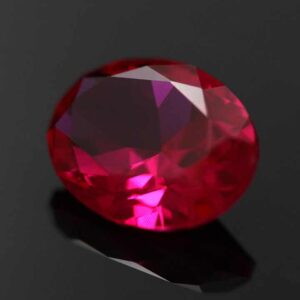
Fluorescence in Natural vs. Synthetic Rubies
| Property | Natural Ruby | Synthetic Ruby |
|---|---|---|
| Fluorescence Strength | Variable (strong in low-iron rubies) | Often strong and consistent |
| Typical Glow Color | Bright red under UV light | Bright red, sometimes slightly pinkish |
| Cause of Fluorescence | Chromium (Cr³⁺), low iron content | Engineered chromium levels, low iron |
| Diagnostic Use | Helps identify origin | Can indicate lab origin when combined with other features |
How Is Fluorescence Used to Identify Synthetic Rubies?
Gemologists often use UV light to test rubies in gem identification. While both natural and synthetic rubies fluoresce red under UV, experts combine this observation with other signs to determine a ruby’s origin:
- Inclusion patterns: Synthetic rubies may show curved striae, gas bubbles, or flux residue.
- Fluorescence intensity: If fluorescence is too uniform or too strong, it may suggest a synthetic origin.
- Spectroscopic analysis: Advanced tools can analyze absorption lines caused by trace elements.
Important note: Fluorescence alone cannot conclusively determine whether a ruby is natural or synthetic. It’s just one tool in a gemologist’s toolkit.
Types of Synthetic Rubies and Their Fluorescence
The method used to grow a synthetic ruby affects its fluorescence properties:
1. Flame Fusion (Verneuil) Rubies
These often show very strong red fluorescence under long-wave UV light. They may also display curved growth lines and gas bubbles visible under magnification.
2. Flux-Grown Rubies
These rubies can mimic natural inclusions and exhibit moderate to strong fluorescence, depending on their chemical purity.
3. Hydrothermal Rubies
Typically moderate in fluorescence and closer to natural rubies in appearance and internal structure. This method produces the most natural-looking synthetic rubies.
Do All Rubies Fluoresce?
No. Not all rubies fluoresce, whether synthetic or natural. The presence of iron is the main factor that suppresses fluorescence. For example:
- Burma (Myanmar) rubies: Strong red fluorescence due to low iron content.
- Thai rubies: Weak or no fluorescence due to high iron levels.
- Some synthetic rubies: If made with added iron or impurities, may show reduced or no fluorescence.
Why Does Fluorescence Matter?
Fluorescence isn’t just a party trick—it has real implications for gem identification, aesthetics, and even pricing:
- Gem Identification: Helps distinguish ruby origins when used with other gemological tests.
- Visual Appeal: Some jewelers enhance a stone’s fluorescence for a glowing effect in certain lighting.
- Marketing: Retailers may emphasize the fluorescence as a desirable feature.
Frequently Asked Questions
Do synthetic rubies glow under UV light?
Yes, synthetic rubies typically fluoresce bright red under long-wave UV light due to the presence of chromium.
Can fluorescence help me tell if a ruby is synthetic?
Not alone. While strong uniform fluorescence may suggest a lab origin, only a gemologist using multiple tests can confirm this accurately.
Is fluorescence in rubies considered good or bad?
It’s neither inherently good nor bad. Some buyers love the glow, while others prefer rubies with minimal fluorescence. It’s often a matter of taste and origin.
Are synthetic rubies with fluorescence real rubies?
Yes. If they are lab-grown with the same chemical and physical properties as natural rubies, they are considered real rubies.
Conclusion: Do Synthetic Rubies Fluoresce?
Yes, synthetic rubies do fluoresce—often strongly—thanks to their engineered chromium content and low iron levels. This property makes them visually appealing and helps in the identification process for gemologists.
Whether you’re a jeweler, a gem enthusiast, or a consumer considering a ruby purchase, understanding fluorescence can add depth to your knowledge and appreciation of these radiant red gemstones.
If you’re shopping for rubies or want to learn more about gemstone identification, contact us today for expert guidance and certified gemstone options.